Photobucket     Photobucket     Photobucket     Photobucket
Showing posts with label science. Show all posts

Thursday, October 28, 2010

You gotta see this


That is an insect. I know it doesn't look like one, in fact I wouldn't have thought it if I hadn't seen it moving. But it is a larva (caterpillar).

We had stopped to get gas and Hubby told us all to come look at an insect he found on the outside of the car. While we aren't doing entomology with 4-H we still are interested in the curious insects that we see fairly often. We managed to capture it and then took it over to the forestry service because one of the men who led our entomology group works there.

He is a real entomologist. I am going to call him Mr Picante.

Anyway, Mr Picante was very interested in the insect. He said it was a Monkey Slug which will turn into a hag moth. He had not actually seen a live one before because they are fairly little (about the size of a nickle) and not something that you would typically notice.

He asked what we were going to do with it and really we had no idea. He said he would be interested in watching it go into a cocoon and then turn into a hag moth so we left it with him. He said he would email us pictures and keep us updated. He said that since it wasn't on a plant it may be very close to making a cocoon and he was right. Two days later the monkey slug made a cocoon, some of the "appendages" were broken off and then stuck to the cocoon by the larva as a camouflage.

I wouldn't want to touch it. It looks fungus-like to me.


Then the next day, hubby brought us a present.


This thing.


Ewww.


It is huge but maybe you can't tell because the picture is small.


Let me show you a larger picture.


That is a penny to give you an idea of the size. It is huge.

Thanks to our friends at the forestry service it was narrowed down to a Hurcules Beetle or a Rinocerous Beetle.

We are going to try to raise it to see what it grows up to be. Then again, if it doesn't live, we aren't really attached to it so we won't be sad.

'Cause we are still kind-of creeped out.

Wednesday, July 1, 2009

What we think we know

Ok, I really love these TED talks. What is TED? According to their website
TED started out (in 1984) as a conference bringing together people from three worlds: Technology, Entertainment, Design. Since then its scope has become ever broader. Along with the annual TED Conference in Long Beach, California, and the TEDGlobal conference in Oxford UK, TED includes the award-winning TEDTalks video site, the Open Translation Program, the new TEDx community program, this year's TEDIndia Conference and the annual TED Prize.


The talks on their website (and on youtube) are short 10-15 minute things and are usually something that will make you think but not something boring. Here is one I just listened to What we think we know where he asks 4 questions that most people think they know the answer to, but might completely be wrong.

Monday, April 6, 2009

Twinkle, Twinkle Little Star

We had the opportunity to go to a star watching party on Saturday night. It was amazing.

We have had a telescope for awhile but neither Hubby or I can figure out how to use it.

Well, we know how to use it, but it is difficult to find what you are looking for when you aren't very good at it.

We got a star wheel and learned how to use it, directions to make an astrolabe and other tips. The two astronomers leading had brought 3 good telescopes and then would focus them on some amazing sights.

The moon with its craters is beautiful, it was like those pictures you have seen, but this was not a picture. Hubby and I had seen Saturn before in my Dad's telescope, but his doesn't give as close of a picture. Saurday, we saw the line of rings and one or two of the moons.

It gave us more ideas on how to get out there and watch what is going on in the sky. They are planning on doing it again in June and we are hoping to be there, as well as one in July.

There are more tips and tricks we learned and will hopefully be able to keep learning more. I will post these as I get time.

Friday, November 21, 2008

100 species challenge - Sweetgum and Greenbriar

I am finally doing my first 100 Species Challange post. With dead camera batteries and too much other stuff going on, this has taken longer than I thought.

  1. Sweetgum

  2. Greenbriar


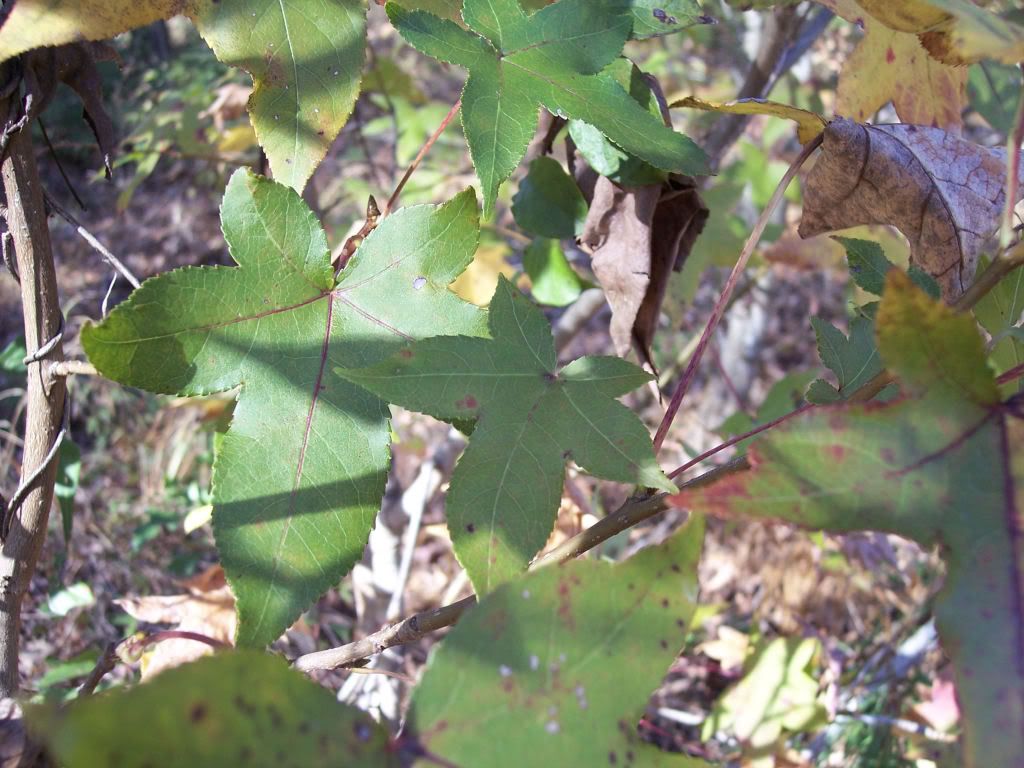
Sweetgum leavesName: Sweetgum

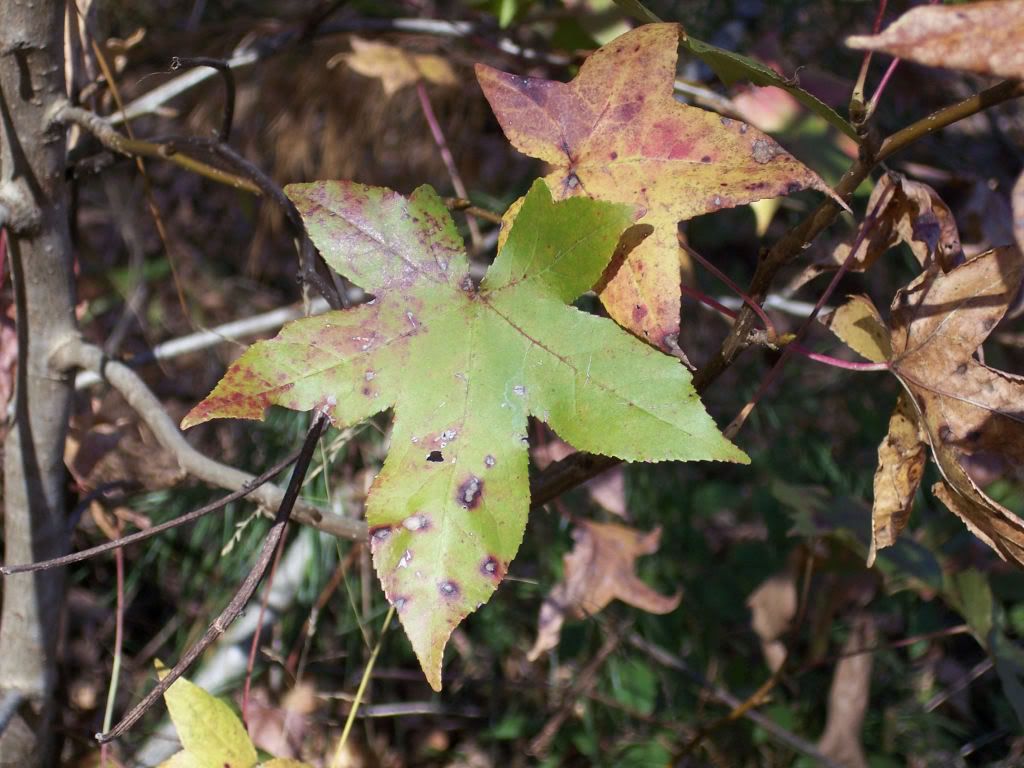
Also known as redgum, american sweetgum, starleaved gum, gumtree and alligator wood. A deciduous tree with leaves that are deeply palmate, or star shaped. When crushed, the leaves have a very strong fragrance, kind of peppery, minty, mentholy. The leaves somewhat resemble maple but are alternately arranged rather than opposite.(see below for an explanation of alternate and opposite)

Sweetgum has a fruit that you would recognize if you ever stepped on one, looking more like a weapon than a fruit. It’s a spiny ball that will clutter up the yard.
Except for the messy balls, it is a beautiful landscape tree and is one of the top producing hardwoods. It is used to make flooring, veneers, furniture, paper pulp and basket making.Sweetgum leaf
The sweetgum sap has been used by oldtimers to make a chewing gum. Supposedly, the leaves when chewed and applied as a paste will releive fire ant bites. I have tried this on Junior and he said it helped, but it took awhile before I had the taste out of my mouth (think really, really strong mint gum). Since I avoid fire ant beds, I haven't tried this on myself. Yep, I am a wimp.

----------------------------------------------------------


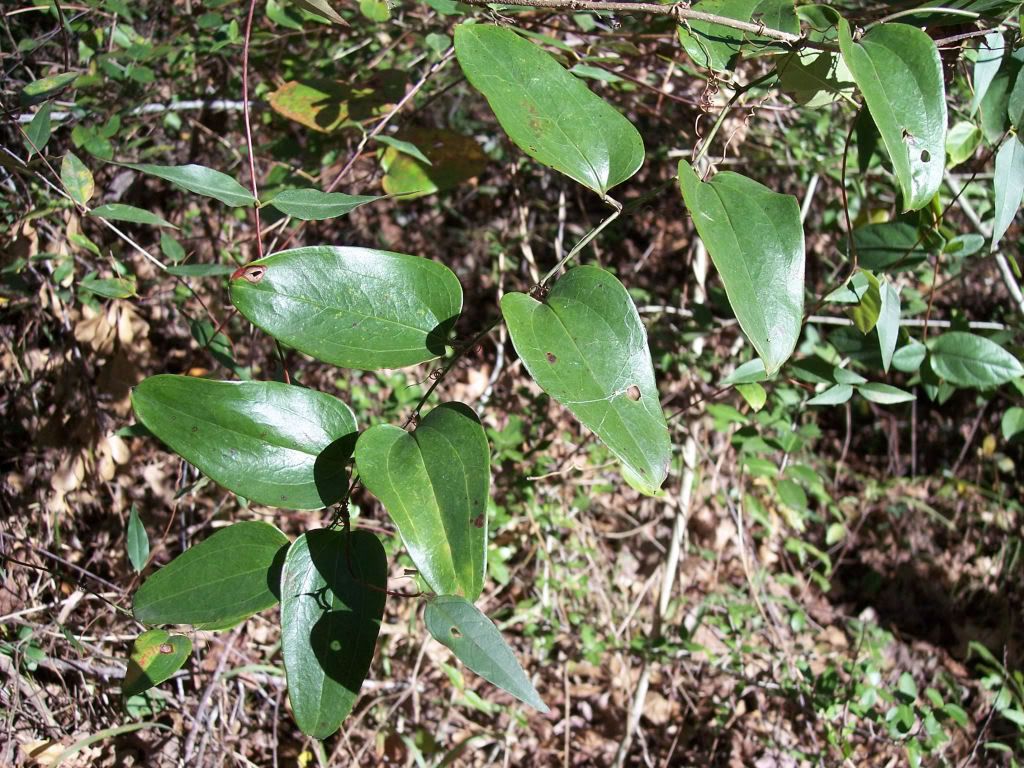
Greenbriar leavesName: Greenbriar

Also known as as horsebrier, catbriar, stretchberry, tramps troubles, blasphemy vine and hellfetter.

A common woody vine that grows in the same area as sweetgum. The leaves are very glossy, almost waxy looking and are broadly rounded. It is the only vine in the United States that has both thorns and tendrils.

The vine can form a thick thicket that is home and food to a variety of wildlife. The deer graze upon the leaves, birds eat the berries and cottontails make their home in its thick cover.
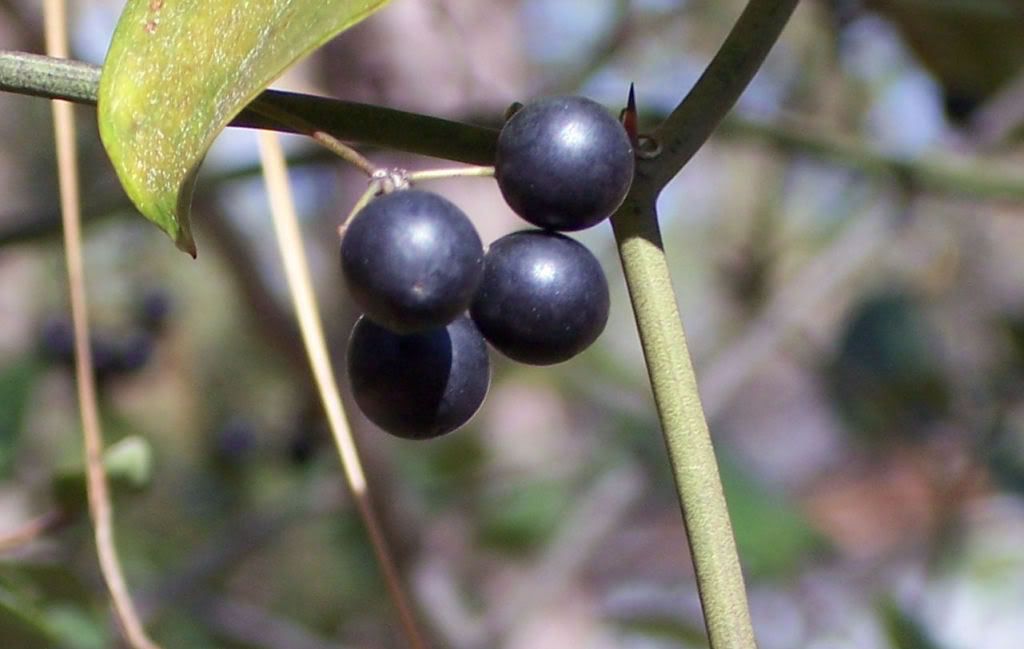
Greenbriar berries, notice the thorn poking out from behind
The berries can be mixed with the sap of the sweetgum tree, to make the gum stretchier. I have broken open these berries and there is a thin, clear stretchy membrane that really is elastic-like.

The young shoots, tendrils and leaves can be cooked as asparagus, ro eaten raw. The roots when crushed, washed and strained produce a red powder that can be used as a gelatin. This powder can be added to soups as a thickening agent or mixed with tannic acid as a soothing salve for bites, minor burns, or abrasions.

----------------------------------------------------------


While looking this information up, I found this book which looks like a wonderful resource. I love the look of this book, I was able to veiw some of it and found it a huge wealth of information. That is where I got alot of the info on the Greenbriar.
Ok I must confess, I just borrowed the graphic from Amazon. So if you want to see inside the book, you have to go to Amazon. You can just click here.


----------------------------------------------------------


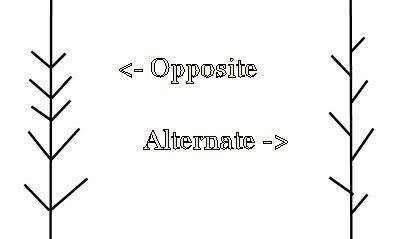
I promised to explain alternate and opposite. Here goes. Then you look at a branch that has leaves they will be either alternate or opposite. Opposite leaves would be like your 2 arms. They are on opposite sides of the body. Alternate means they are not opposite. They can be very close to opposite, but if they aren't even, it is alternate. Here is a little diagram I threw together to give a visual.
alternate and opposite

Tuesday, November 11, 2008

100 species Challange

I was over at the Charlotte Mason Blog Carnival at Jimmie's One Child Policy blog (well worth checking out even without the carnival) and found this entry:

Faith Alterton shares a most creative post at Blessed Quietness -- And yet another use for mud. That got your attention, didn't it?

Of course I had to check it out, and then I looked around and found the 100 species challenge.


What is the 100 Species Challenge you ask?


Well, it seems the person who came up with this challenge had read a book that mentioned most people nowadays cannot identify 100 species of plants within walking distance. So she took the challenge and has challenged others to do the same, identify 100 species of plants in your area.

You can do this on your own or you can blog about it. If you blog about it, these are the official rules.


The 100-Species Challenge


  1. Participants should include a copy of these rules and a link to this entry in their initial blog post about the challenge.

  2. Participants should keep a list of all plant species they can name, either by common or scientific name, that are living within walking distance of the participant's home. The list should be numbered, and should appear in every blog entry about the challenge, or in a sidebar.

  3. Participants are encouraged to give detailed information about the plants they can name in the first post in which that plant appears. My format will be as follows: the numbered list, with plants making their first appearance on the list in bold; each plant making its first appearance will then have a photograph taken by me, where possible, a list of information I already knew about the plant, and a list of information I learned subsequent to starting this challenge, and a list of information I'd like to know. (See below for an example.) This format is not obligatory, however, and participants can adapt this portion of the challenge to their needs and desires.

  4. Participants are encouraged to make it possible for visitors to their blog to find easily all 100-Species-Challenge blog posts. This can be done either by tagging these posts, by ending every post on the challenge with a link to your previous post on the challenge, or by some method which surpasses my technological ability and creativity.

  5. Participants may post pictures of plants they are unable to identify, or are unable to identify with precision. They should not include these plants in the numbered list until they are able to identify it with relative precision. Each participant shall determine the level of precision that is acceptable to her; however, being able to distinguish between plants that have different common names should be a bare minimum.

  6. Different varieties of the same species shall not count as different entries (e.g., Celebrity Tomato and Roma Tomato should not be separate entries); however, different species which share a common name be separate if the participant is able to distinguish between them (e.g., camillia japonica and camillia sassanqua if the participant can distinguish the two--"camillia" if not).

  7. Participants may take as long as they like to complete the challenge. You can make it as quick or as detailed a project as you like. I'm planning to blog a minimum of two plants per week, complete with pictures and descriptions as below, which could take me up to a year. But you can do it in whatever level of detail you like.


Because of 4-H wildlife this year, we do have a bit of a head start. This is going to be a fun challenge for us, and may make it easier to study for Wildlife contest next year, a contest that 8 & 9 year olds compete with highschool kids. To be honest, I am not quite sure who is at the disadvantage, LOL.

The first plants will be posted later today. Because of wildlife, and because I believe the original author complaining of the lack of botanical knowledge was referring to wild species, I am going to attempt to limit us to stuff we have not planted. For instance, I have a lovely rosemary bush but I know what rosemary is, I know what it does, etc.

I don't specify native because . . . there are many, many invasive plants that are non-natives, not just kudzu but also pretty things like honeysuckle, which would be useful to know more about. Also, to be honest, with plants you don't know, you don't know if they are native or not until you research them. I don't want us to research and then find out they are non-native and tell the kids "oops, we can't use this one." Besides on the wildlife contest there are non-natives like honeysuckle.

Any one else care to join me on this challenge?